Jet lag isn't fatigue. It's a clock out of sync.
Your body runs on an internal clock — the circadian rhythm — that governs sleep, alertness, digestion and body temperature. Crossing time zones faster than it can adjust puts every system out of phase.
Unaided, your clock shifts about one hour per day.
A Paris–Tokyo flight crosses seven time zones. Left alone, your body needs days to catch up — 2 to 4 days of degraded sleep, focus and mood. Timing the right signals during the flight starts the shift before you land.
THE SCIENCE BEHIND EOLE
Your Body Responds to Four Signals. EOLE Knows When to Use Them.
Light exposure
Light is the strongest signal your clock receives. Seeking it — or avoiding it — at precise moments shifts your rhythm in the right direction.
Sleep timing
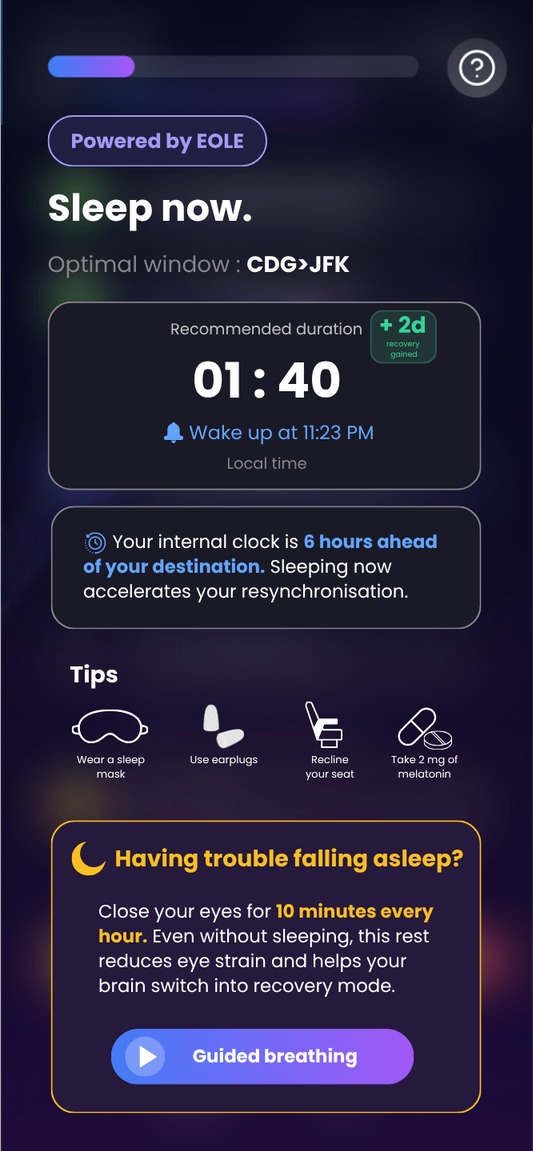
Sleeping inside your optimal window anchors the shift. Sleeping outside it fights your own biology and slows adaptation.
Hydration
Hydration supports your body's ability to adapt across time zones. Staying properly hydrated helps maintain alertness, circulation and cognitive performance throughout your journey.
Breathing & Movement
Gentle movement and guided breathing reduce the effects of prolonged sitting and travel-related stress. Timed exercises improve circulation, support relaxation and help prepare your body to adapt.
Personalized, not generic
One protocol per traveller, per flight.
EOLE calculates your optimal sleep window from three inputs — then adapts every recommendation to the direction of travel: eastward flights need earlier clocks, westward flights need later ones.
Early bird or night owl — your baseline rhythm changes when signals work best.
The size and direction of the shift set the shape of your protocol.
Flight times, layovers and what awaits on arrival — a meeting, a match, a holiday.